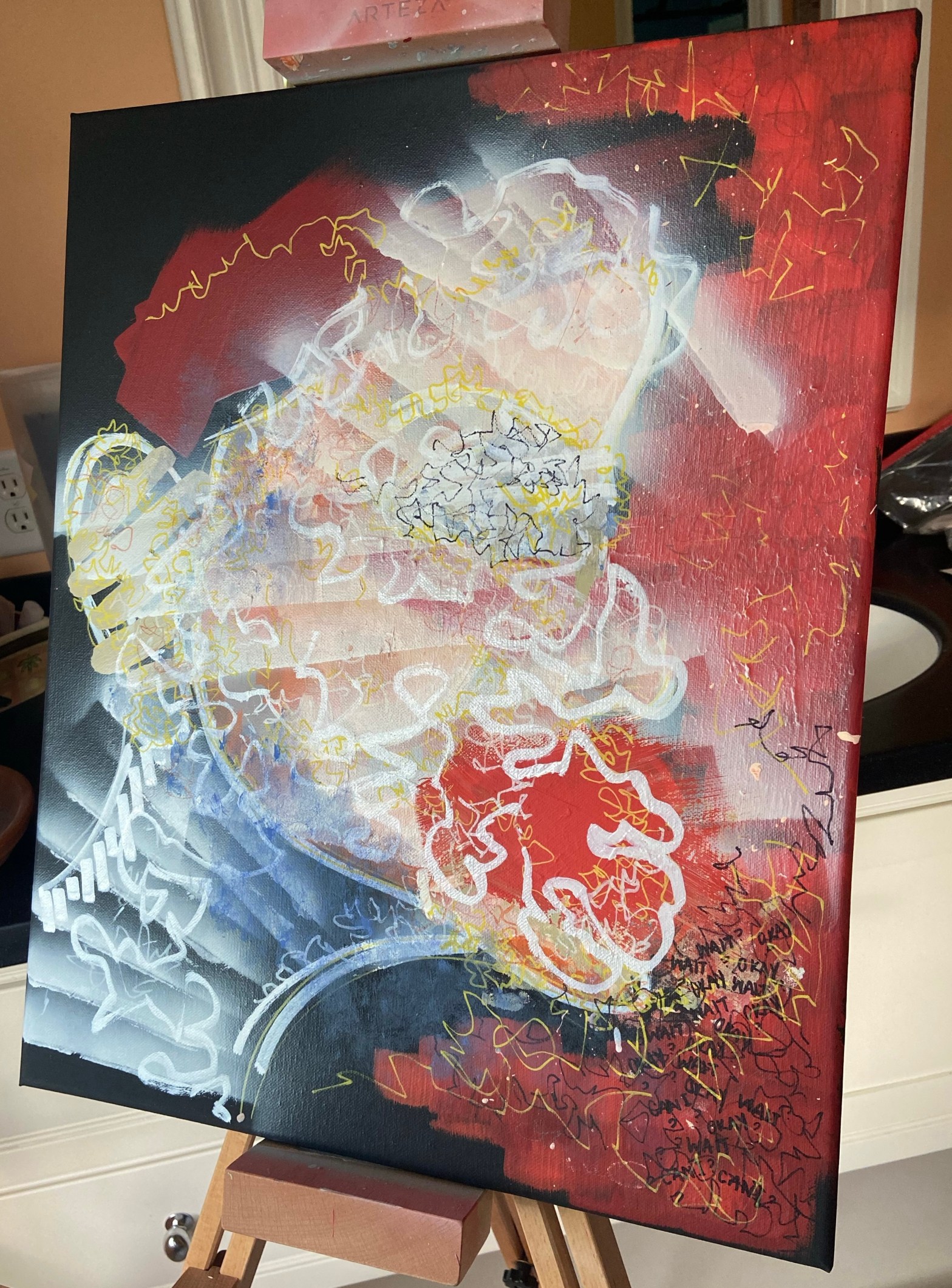
Jack Nicholson famously said in the cinematic ground zero of American nostalgia Easy rider, that “America loves to talk about individual freedom, but they hate to see a free individual.” Three decades before, Karl Jaspers of Germany was opining on the demands made on man* by the modern world that accompany an immense new freedom, and 50 years before that Søren Kierkegaard wrote of the “dizziness of freedom” and the anxiety it causes. Freedom is a momentous virtue, of which we all enjoy to varying degrees, some of us not at all, but this contemplation is not for those who struggle for emancipation, it’s a contemplation of the struggle to be free when it is already an option, it’s a meditation on the individual’s struggle to embody freedom for herself. In this context I began to wonder about the demands and responsibilities of being “free”, not the sacrifices made for freedom, but the demands of exercising freedom in ones individual life. This was all spurred by a reading of Karl Jaspers, but no doubt many philosophers and thinkers can be called upon when contemplating freedom. What the above writers suggest, is that when faced with freedoms churning truth, when we stare down its crushing possibility, we either succeed and assert our selfhood among incredible odds, or it rolls over us like an unexpected swell in the ocean throwing us from our peace of non possibility, leaving us in a wake of confusion and indecision, not unlike Dennis Hopper and Peter Fonda at the end of the film when Fonda tells Hopper, “we blew it.”
In what follows I argue that freedom is not such an easily enjoyed virtue, rarely does it produce serenity, and now more than ever, it involves a monumental inner battle, a battle of the ages bound up in the sentiment, freedom is struggle.
Freedom and its Demands
Karl Jaspers wrote in Man in the Modern Age in 1931 about what it takes to become a truly free and creative self in the age of the mechanization and corporatization of societal roles, the invention of mass life, and the lack of an externally imposed destiny, or loss of vital tradition, all of which produce a staggering deficit of attention,
“To-day the mental creator has, it would seem, to live, not merely as a solitary, but as if he were making a fresh beginning, in touch with no one, apart alike from friends and from foes…unsustained by earlier generations or by the present generation, cut adrift from a really vital tradition, the mental creator can no longer be a member of a community of persons engaged in the possible perfectionment of a path. He does not take his steps nor draw his conclusions in an overriding environment. He is menaced by the haphazard, in which he cannot march boldly forward, but squanders his energies. The world does not impose on him any sort of mission. He must choose his course at his own risk. Without response, or only with a false response, and without a genuine adversary, he loses the necessary self-assurance. If he is to escape from this lack of concentration, he will need almost superhuman energy. In the absence of an unfaltering and lucid education, an education with a definite goal, an education thanks to which the highest becomes attainable, he will have to zigzag amid continuous losses, and will perhaps at the end begin to see the possibility of making a real start when the time for a start has slipped by! It is as if he had been deprived of breath, inasmuch as he is no longer surrounded by the world of mental reality out of which the individual must grow if he is to be the mental creator of anything durable.”
Superhuman energy, lucid education with a definite goal, self-assurance, these are just some of the qualities necessary, according to Jaspers, for us to wrestle our self-hood, our “existence”, from this new world of freedom which is full of commercial and further, unnamable forces that plunder our minds and daily schedules for the fruits of our energies, leaving us with no recourse but to turn on the television or youtube at 9pm and forget about our fleeting aspirations. Freedom for Jaspers is a lack of a worldly mission imposed on us, rather, we must decide our mission for ourselves while immersed in immense forces which aim to stop us from ever getting a start. We must create this life from pure scratch so to speak, and to do so often begets solitude. So for Jaspers, this freedom divorced from a cultural tradition, or even an “overriding environment” from which we can orient our self, overwhelms us, and we are left stumbling and zigzagging, trying to recover our sense and place in the world.
Back in 2004, in one of the most truthful yet inspiring commencement speeches of our time, Toni Morrison stated “there is nothing, believe me, more satisfying, more gratifying than true adulthood. The adulthood that is the span of life before you. The process of becoming one is not inevitable. Its achievement is a difficult beauty, an intensely hard won glory, which commercial forces and cultural vapidity should not be permitted to deprive you of.” Jaspers might substitute “adulthood” here for “self-hood” or that elusive target we aim to hit out in the oblivion of never ending streams of media, political stereotypes, minute long trends, or simply, “commercial forces and cultural vapidity”.
As such, we’ve overthrown the traditions of our past that at one time secured us into a certain adulthood or selfhood, though it was not always the one we might have hoped for. The tight collars and corsets that seemed to strangle us and deprive us of expressing our individual excesses then, have been traded in for new ethereal, subtle, metaphysical collars and corsets comprised of the myriad of forces of our epoch, most notably a general precariousness, which instead of deprive, have flooded us with individual excesses that aren’t truly our own, but imitations of imagery discovered and bought online. Without this selfhood, or even the self assurance first necessary to reach it, many of us are left feeling anxious and depressed, left to clean up after ourselves with obsessive spirituality, gratitude journaling, well-being commerce, SSRIs or even now, Ketamine and Mushrooms.
The point being, this freedom we so espoused, the kind that we won from the formation of society and the subsequent subversion of it, is suffocating us, and only a magnificent personality, responsibility, or as Thomas Mann put it in The Magic Mountain, “moral remoteness”, can supply us with the possibility to become our “self” in such an environment. It makes sense then, the heightened focus on Buddhism and oneness in an environment where the self has lost its meaning, that we should become receptive to a philosophy which locates the “self” as the ultimate illusion. And it very well may be the self is an illusion from a theoretical point of view, but in praxis the “self” is not an illusion only as much as it becomes one from a certain selfish perspective. This self becoming an illusion is exactly what’s happening as we’ve grown atomized and further embedded in mass society and mass life, disconnected from our geography and familial reciprocities, or the “vital tradition” that imposed a self upon our self so many centuries before. The “self” as understood by Maurice Merleau-Ponty, is brought into being through the relationships it has with the world and with other “selves”. As these relationships grow weaker, because they are mediated by the Spectacle (described above as the distractions of modern life) as described by Guy Debord, we grow weaker to respond to the immensity of freedom before us. We become implanted in a feedback loop where the newfound freedom of our day and its overwhelming commerce of distraction deprives us of the relationships found in a strong and committed community, relationships which strengthened our “self” and enabled us at one time, though, always difficult it likely was, to deal more decisively with the freedom bestowed upon us.
Thus we come back to our Jack Nicholson and Easy Rider, our individual freedom as some carefree effortless state of being is nostalgia now, and perhaps even, it was nostalgia when the film was made. What we see instead are gestures of freedom that mask an indelible confusion. Who can truly bear the responsibility of this total freedom and become themself in its wake? Few, very few, instead we subjugate ourselves into a tangling of shallow relationships that comprise this new distracted world, to do otherwise is as alienating as it is rejuvenating. Freedom exists almost everywhere in America, but few are equipped to handle it. As to Jaspers point, it’s found in a sort of solitude that at one time was accompanied by solidarity, the latter of which has fallen into further decay with the evolutions of mass life, leaving us only with solitude. Instead, we must struggle against all odds to become, rather, to be, ourselves in an environment where it is neither guaranteed by a strict adherence to tradition, but also never not immediately available for our taking, given that we can do what Jaspers says is our only option left,
“To live at harmony with the powers of our world without being absorbed by them.”
 gregorykelsh